
I was recently invited to deliver an online lecture for the year-three students on the Applied Renal & Medical Engineering module at UWE Bristol – a session focused on the clinical applications of surgical lasers in urology. It’s not often I get the chance to step out of the sales and commercial world, and it turned out to be a genuinely worthwhile experience.
Preparing the lecture meant going back to fundamentals I hadn’t revisited in a while. In endourology theatres, we often talk about Holmium, Thulium, wavelengths, and pulse widths frequently, but I never really stop to think about why these lasers behave the way they do. Revisiting the physics – stimulated emission, population inversion, and the fact that the wavelength is dictated by the electron energy levels of the lasing medium, reminded me how much of this job is built on some fundamental science. I even had to remind myself (again) that YAG stands for – Yttrium Aluminium Garnet, for the record!
For our part at novus med, we work with several different types of surgical laser; Ho:YAG, Thulium Fibre Laser (TFL) and pulsed Thulium pTm:YAG – each built around its own lasing medium, cavity design, and corresponding wavelength. Even though they’re all tuned to the infrared end of the spectrum, and all chosen because of how strongly water absorbs light in that region, they behave quite differently in tissue and stone. The students really enjoyed hearing how those differences in wavelength and cavity design translate into very different clinical interactions: dusting vs fragmentation, cutting vs coagulation.
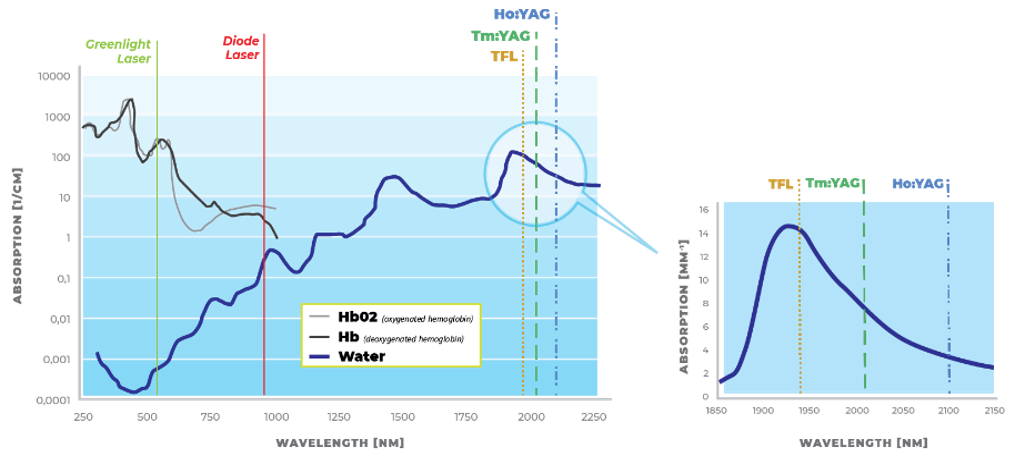
Illustration care of Dornier & adapted from Teichmann, H.O., Herrmann, T.R. & Bach, T. Technical aspects of lasers in urology. World J Urol 25, 221–225 (2007). https://doi.org/10.1007/s00345-007-0184-5
The videos made a big difference too. Clinical engineers don’t always get to see the clinical side of the devices they support, so showing them real footage of stone dusting, popcorning, and an endoscopic enucleation of prostate procedure helped tie everything together. They could see how a short‑pulses cause the stone to visibly jump, whilst longer‑pulses lead to less retropulsion. It’s one thing to talk about photothermal versus photomechanical effects; it’s another to watch them happen.
Dornier Thulio Captive vs Standard mode video
Safety also sparked some discussion, especially around the Nominal Ocular Hazard Distance (NOHD) and the ongoing debate about whether goggles are always necessary in endourology. The BAUS Endourology Safety Paper suggests that the real‑world risk is extremely low, and goggles can sometimes reduce situational awareness more than they improve safety. It’s a topic with strong opinions on both sides, and the students appreciated hearing the reasoning behind each perspective. Here’s the full article – BAUS statement: Recommendation on the use of protective eyewear in endourological laser procedures https://doi.org/10.1111/bju.16664
Overall, the session reminded me how much engineering sits behind every clinical effect. Lasers are complex! They’re carefully designed systems where physics, optics, engineering constraints and clinical need all intersect. Seeing the students connect those dots, from stimulated emission to fibre optics to stone fragmentation was the most rewarding part of the day.
I’m pleased to say I’ve been invited back to deliver the lecture again next year, which suggests the session landed well, and with any luck, I’ll finally remember what YAG stands for without checking my notes!
If you would like to know more about our comprehensive laser portfolio, please get in touch.











 Call
Call